 Padua City Guide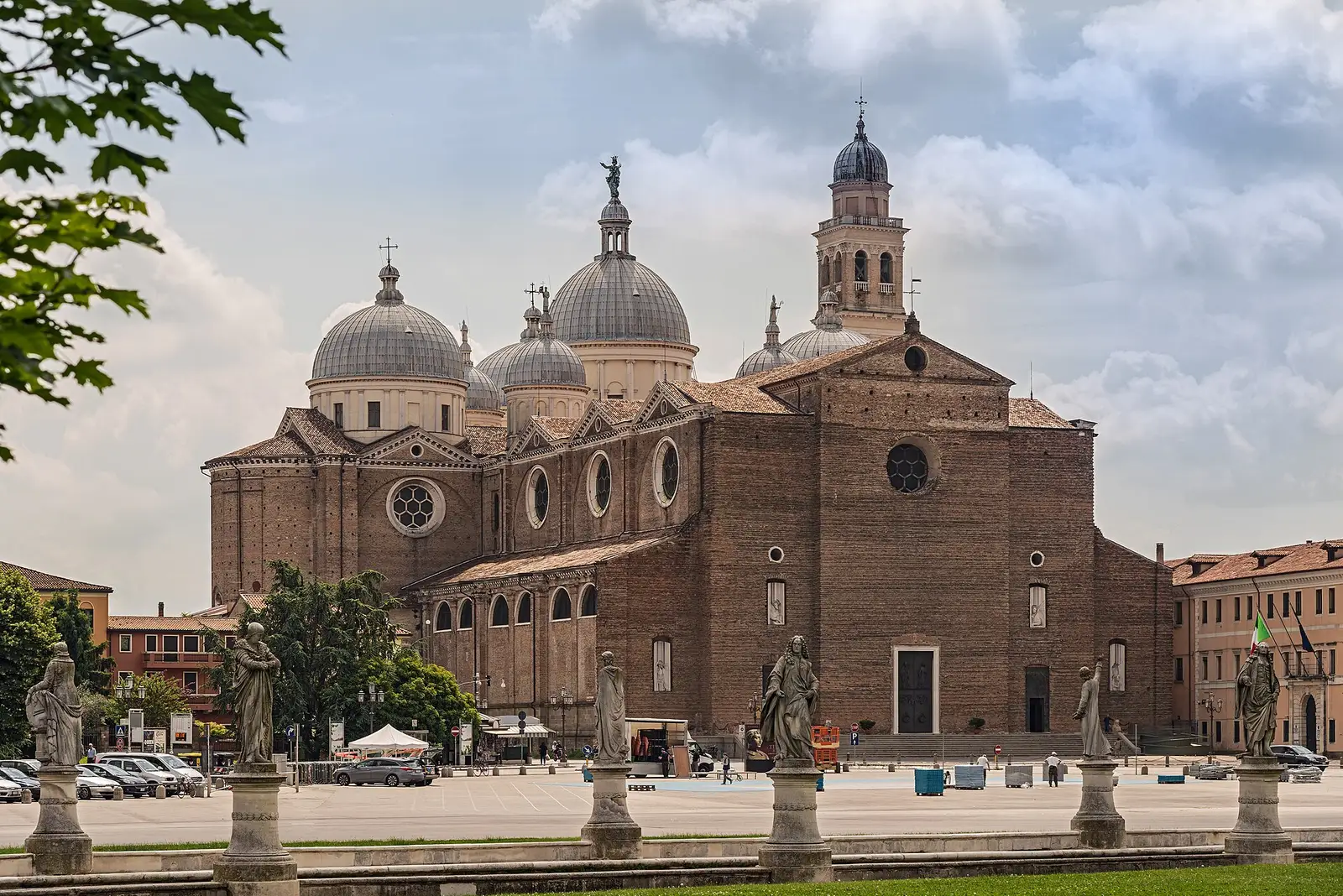
The santa giustina padua travellers usually photograph from across Prato della Valle — the enormous brick mass with its tall bell tower — is not a parish church but a working Benedictine abbey, and it is one of the largest churches in the Christian world, roughly 122 metres long. Behind its sober facade the scale keeps compounding: a forest of white columns under a ceiling ninety feet high, the urn of St Luke the Evangelist in the transept, relics of the Apostle Matthias, the martyrs' corridor leading to the chapel of Padua's first bishop, and behind the high altar the inlaid choir stalls and Paolo Veronese's huge Martyrdom of Saint Justina. Entry is free, every day, with hours that follow the liturgical calendar rather than a tourist timetable — which is the one practical complication this page resolves. The abbey anchors the southern cluster that includes Prato della Valle and the botanical garden, so it costs nothing to fold into an afternoon loop. Everything else about the city lives on the Padua City Guide homepage.
Quick answer Free entry, opening hours, Masses and where St Luke lies
Checked on 12 September 2026: the basilica is free to enter, generally open in two windows — roughly 07:30-12:00 and 15:00-19:00 (later close in summer) — with hours that shift on the liturgical calendar, so confirm on the abbey's site. Masses run on Saturday at 18:00 and Sunday at 08:15, 09:30, 11:00 and 18:30. The tomb of St Luke the Evangelist is in the transept chapel, marked by the urn raised there; the Apostle Matthias's relics rest in another chapel. Come for the scale, the Veronese altarpiece and the choir, then walk straight across to Prato della Valle and the botanical garden two minutes north.
Key takeaways
- Free entry, open daily — no ticket, no slot, no booking for the basilica itself.
- Indicative hours: 07:30-12:00 and 15:00-19:00; summer afternoons stretch later — verify on the abbey site.
- St Luke the Evangelist's relics lie in the transept chapel; St Matthias's relics are venerated in a side chapel.
- One of the largest churches in the world — about 122 metres long.
- Masses: Sat 18:00; Sun 08:15, 09:30, 11:00 and 18:30.
Key facts
Opening hours
| Mornings (indicative) | 07:30–12:00 |
|---|---|
| Afternoons (indicative; until 20:00 in summer) | 15:00–19:00 |
Closed Open every day including Sundays; hours shift with the liturgical calendar and between summer and winter — confirm on the abbey's site before going
Admission
- Adult
- Free entry to the basilica
- Reduced
- Not applicable — the basilica is free
- Free
- Everything in the church is free; guided visits by the monks for groups are free of charge (offer welcome)
Planning it
- Time needed
- 30 to 60 minutes
- Book ahead
- Optional — walk-up usually fine
- Address
- Via G. Ferrari 2/A (monastery), basilica on the Prato della Valle side, 35123 Padova
One of the largest churches in the world, next to Prato della Valle
Santa Giustina's site is older than the church by a millennium and a half: the young Justina was martyred here on 7 October 304, buried in a Christian cemetery outside the Roman city, and a first basilica rose over her grave soon after 520. Benedictine monks settled at the abbey by 971, and for six centuries the monastery grew into one of the richest landowners in the Veneto, its library and scriptorium tied closely to the young university across the fields. The earthquake of 1117 — the same one that wrecked the cathedral — levelled that early basilica, sparing only the small Martyrs' chapel you can still enter today.
What you see now is the early-modern answer to that ambition: begun in the early sixteenth century and finished over the following hundred-odd years, a colossal Latin-cross church of pale stone columns and brick vaulting. The nave runs about 122 metres, the facade still waits for its marble skin, and the bell tower stands over the monastery roofs. Architecture guides count it among the fifteen or so largest churches in the Christian world, a ranking you feel rather than measure: entering from the Prato side, the columns simply keep arriving. The monastic community still prays the liturgy of the hours here, so visits share the building with bells, chant and — if you time it to Sunday 11:00 — a conventual Mass with the monks.
- 304: Justina is martyred under Maximian and buried at the site.
- After 520: the first basilica is built over her grave.
- 971: Bishop Gauslinus restores a Benedictine monastery under the Rule of St Benedict.
- 1117: the earthquake destroys the early basilica; the Martyrs' chapel survives.
- 1174 and 1177: the bodies of St Justina and St Luke the Evangelist are rediscovered.
- 16th-17th century: the present colossal church is built.
Inside: St Luke's tomb, the Veronese altarpiece and the choir
Walk the church in one long line: down the nave, into the transept, then behind the high altar. Everything that follows is free, and lighting is dim in the side spaces — your eyes need a minute to adjust.
The Chapel of St Luke and the relics of St Matthias
In the northern transept, the Chapel of St Luke holds the abbey's headline relic: the urn with the remains of the Evangelist, rediscovered here in 1177 and raised in a monumental marble setting. Tradition pairs the Evangelist's tomb with the body of the Apostle Matthias, chosen to replace Judas, whose relics rest in another chapel of the church — one of the very few apostolic tombs outside Rome. The chapels are quiet, signed, and usually empty even on busy days; candles and explanatory panels are at the entrance.
The choir, Veronese and the martyrs' corridor
Behind the high altar, the great wooden choir — the monks' stallwork, carved in the sixteenth century to designs associated with the Florentine monk Martino da Firenze — frames Paolo Veronese's monumental Martyrdom of Saint Justina, painted in the 1570s for the high altar and now placed so the community faces it at prayer. From the choir you reach the Corridoio dei Martiri, the corridor of martyrs, and the Sacello di San Prosdocimo: the tiny early-Christian chapel dedicated to Padua's first bishop, which survived the 1117 collapse and preserves the site's oldest masonry.
Visiting: hours, Masses, guided tours and the cloisters
Entry is free with no ticket system. Hours follow the liturgical calendar and change between summer and winter: as a working rule, mornings 07:30-12:00 and afternoons 15:00-19:00, with the afternoon close pushed to 20:00 in the warm months — always confirm on the abbey's site, which publishes monthly posters. The inner cloisters are normally closed to the public and are seen only on guided visits: the monastic community organises free guided tours for groups on request (form on the abbey site), while a lay volunteer is often present at the basilica entrance at posted times for individuals and small groups who want the choir, corridor and chapel explained.
What to see inside, at a glance
Use this checklist to order a half-hour visit so that the big names fall in the right sequence.
| Feature | Location in the church | Why it matters |
|---|---|---|
| Chapel of St Luke | Northern transept | Urn with the relics of the Evangelist, rediscovered 1177 |
| Relics of St Matthias | Side chapel | Apostolic relics — rare outside Rome |
| Veronese altarpiece | High altar / choir area | Paolo Veronese's Martyrdom of Saint Justina, 1570s |
| Choir stalls | Behind the presbytery | 16th-century inlay work to designs associated with Martino da Firenze |
| Corridoio dei Martiri and Sacello di San Prosdocimo | Beyond the choir | Early-Christian chapel that survived the 1117 earthquake |
| The nave itself | Main axis | About 122 m long — among the largest churches in the world |
There is no ticket for the basilica itself — every option below is either free directly, arranged with the abbey, or a paid guided city walk from our catalogue. Hours and arrangements follow the abbey's own site (abbaziasantagiustina.org), checked on 12 September 2026.
Just walk in; arrange a monastic guided visit only if you want the choir and cloisters, which are otherwise closed.
| Option | What it covers | Price | Booking | Book |
|---|---|---|---|---|
| Basilica entryEveryone | Nave, transept, St Luke's chapel, Veronese altarpiece — within opening hours | Free | Abbey website | Official site |
| Guided visit with a monk (groups, on request)Groups and curious individuals | Adds the choirs, martyrs' corridor and normally-closed cloisters | Free of charge (offer welcome) | Guided visits page | Official site |
| Guided city walk across Prato della ValleFirst-time visitors | See tour card for departures | See tour card | Check Availability | Check Availability |
| Southern Padua day tour incl. the abbey districtHalf-day travellers | See tour card | See tour card | Check Availability | Check Availability |
Santa Giustina and the Basilica of Saint Anthony compared
Both are colossal, free, and within a ten-minute walk of each other; the practical differences below come from the two institutions' own communications and were checked on 12 September 2026. See also our full Basilica of Saint Anthony page.
| Santa Giustina (this page) | Basilica of Saint Anthony | |
|---|---|---|
| Dedication | St Justina, martyred 304, and St Luke's tomb | St Anthony of Padua (d. 1231), the city's pilgrimage focus |
| Size | About 122 m long; among the largest churches in the world | Vast pilgrimage complex with multiple domes and chapels |
| Entry | Free, no security line, calm even at midday | Free, with security screening and a dress code |
| Signature art | Veronese altarpiece, inlaid choir, early-Christian chapel | Donatello bronzes, Gattamelata monument, Treasury chapel |
| Best for | Scale, silence, Evangelist relics | Pilgrimage atmosphere, Renaissance sculpture |
The abbey church of Santa Giustina seen across Prato della Valle — roughly 122 metres of sixteenth-century brick.
Abbey of Santa Giustina on the map
The abbey closes the southern edge of Prato della Valle, with the botanical garden and the Basilica of Saint Anthony forming the rest of the loop. Pins mark the entrances and the walking sequence.
Guided tours that include Santa Giustina
The basilica is self-guided by design, but the abbey district explains itself better with a guide; these catalogue departures cover the square and its monuments.
 from $69.61
Padua: Small-group walking tour with the Scrovegni Chapel
Best value: the slot and the fresco context in one booking
Check Availability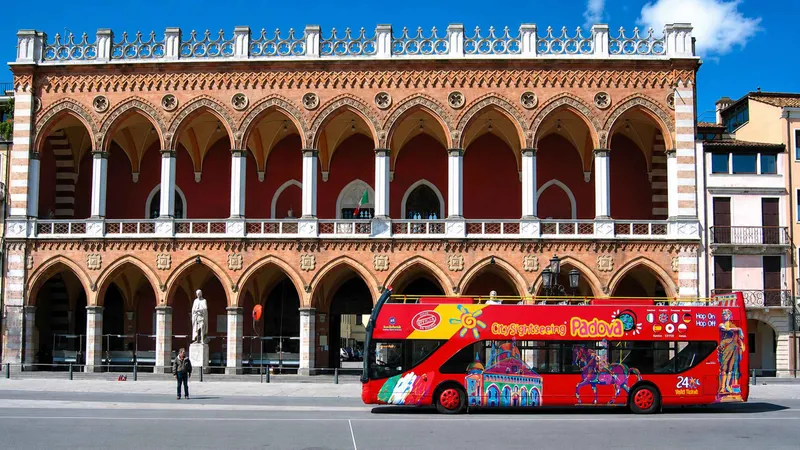 from $17.40
City Sightseeing Padova Hop-On Hop-Off Tour: 24-Hour Ticket
Lowest-cost loop for mobility-limited or first-hour orientation
Check AvailabilityPrices, ratings and details are the platform's own, checked in Q3 2026; dollar figures are the listed prices — the platform bills in your account's currency.
Frequently asked questions about Santa Giustina
Is Santa Giustina free to enter?
Yes — entry to the basilica is free during opening hours, with no ticket, no slot and no booking. The only paid things on this page are the optional guided city walks in our catalogue, and the abbey's own monastic guided visits are free of charge (an offer is welcome).
Where is the tomb of St Luke the Evangelist?
In the Chapel of St Luke in the transept, where his relics — rediscovered at the abbey in 1177 — rest in a monumental urn. The relics of the Apostle Matthias are venerated in another chapel of the same church.
What are the opening hours?
As a working rule, mornings 07:30-12:00 and afternoons 15:00-19:00, with summer afternoons stretching to about 20:00; exact times shift with the liturgical calendar and the seasons, and the abbey publishes monthly schedules on its site — check before a special visit.
How large is the church, really?
About 122 metres long, which puts it among the fifteen or so largest churches in the Christian world. The nave's height and the repetition of columns make the size felt more than measured — walk the full axis once to understand the ranking.
Can you visit the cloisters of the abbey of santa giustina?
Not on your own — the inner cloisters are normally closed to the public. The monastic community opens them on free guided visits for groups arranged through the form on the abbey's website; individual visitors can often join the volunteer-led explanations at the basilica entrance at posted times.
When are Masses celebrated?
Saturday at 18:00; Sunday at 08:15, 09:30 (parochial), 11:00 (conventual, with the monastic community) and 18:30. The 11:00 Sunday Mass is the one to attend for the chant; sightseeing continues around it in the nave.
How do I combine Santa Giustina with Prato della Valle and the garden?
The three form one loop: the abbey faces the square's southern rim, Prato della Valle's canal ring takes ten minutes to walk, and the botanical garden entrance is two minutes beyond it. In summer start at the abbey at 15:00 and finish at the garden before its 18:15 last entry.
What to visit near the Abbey of Santa Giustina
The abbey is the southern anchor of the city's sightseeing — these stops complete the loop:
Prato della Valle
Italy's largest square, directly across the abbey's forecourt.
Botanical garden
The UNESCO garden of 1545, two minutes north of the abbey.
Basilica of Saint Anthony
The pilgrimage basilica with Donatello's Gattamelata, ten minutes north.
Padua in 1 day
How to sequence the southern loop into a single day.
Where to eat
Trattorias and bacari around the square and on the way back to the centre.
Reviewed Q3 2026 (July–September 2026); next review Q4 2026. Prices, hours and terms are set by the venue or operator and confirmed at checkout.
We may earn a commission if you book through one of our links, at no extra cost to you. Full affiliate disclosure